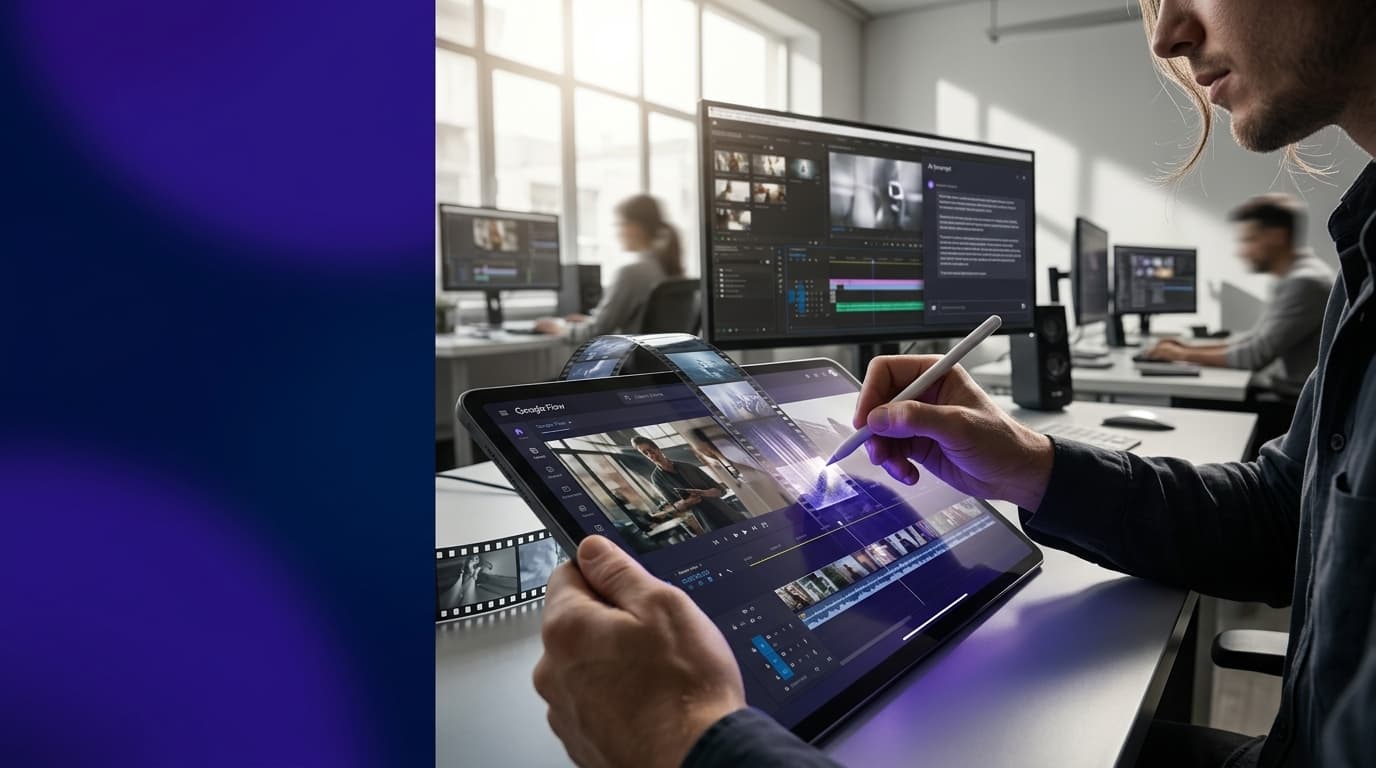
Google introduces Gemini Omni for multimodal video generation and editing
··5 min read
The new model enables natural-language video manipulation, though advanced speech-editing features remain restricted pending safety tests.
Google DeepMind has introduced Gemini Omni, a multimodal generative AI model designed to treat video as a fluid, editable canvas. The first iteration, Gemini Omni Flash, is currently rolling out globally to Google AI Plus, Pro, and Ultra subscribers through the Gemini app and Google Flow. Google will also expand access to YouTube Shorts and the YouTube Create App later this week at no additional cost.
The release marks a deliberate shift from static media generation to dynamic, multi-turn manipulation. Where previous models required complex prompting to output brief, standalone clips, Gemini Omni allows users to generate and edit video natively using a simultaneous combination of text, image, audio, and video inputs.
From static images to temporal space
The model architecture builds upon the foundation of Nano Banana, Google's native image generation capability introduced last year. While Nano Banana focused on compositional control and character consistency in still images, Gemini Omni extends those principles into temporal space. Translating two-dimensional accuracy into video requires a system that understands how objects move and interact over time.
To solve this, Google DeepMind designed the Omni models to incorporate intuitive physics, historical context, and fluid dynamics. This grounding in real-world logic prevents the structural warping and hallucinated geometry that typically plague AI-generated video when subjects move or interact with their environments. For example, if a user prompts the model to place a glass orb in a moving hand, the system accurately renders lighting changes, physical weight, and environmental reflections across the sequence.
Koray Kavukcuoglu, chief AI architect at Google and CTO of Google DeepMind, framed the release as a structural evolution of the company's ecosystem. "We're introducing Gemini Omni, where Gemini's ability to reason meets the ability to create," Kavukcuoglu stated.
Conversational editing and enterprise utility
The most significant technical departure from competing video generators is Gemini Omni's editing interface. The model operates conversationally, allowing users to upload existing footage and apply natural-language prompts to alter specific elements across multiple turns.
Instead of regenerating an entirely new clip when a prompt is adjusted, the model retains the contextual constraints of the original video. Users can instruct the AI to swap backgrounds, stabilise shaky footage, change wardrobe elements, or shift camera angles without losing the fundamental identity of the primary subject.
This precision has immediate implications for business workflows. Google has explicitly positioned Gemini Omni for enterprise adoption, noting that the model can streamline complex post-production pipelines and generate interactive virtual try-ons for e-commerce platforms. By integrating the model directly into the Agent Platform API and Google Flow, the company is attempting to make conversational video editing a standard utility rather than a niche technical skill.
Speed and architectural efficiency
The decision to launch the Flash variant of the model first highlights Google's priority on speed and computational efficiency. Like the broader Gemini 3.5 Flash text models announced concurrently, Gemini Omni Flash is a transformer-based architecture optimised for low latency. It was trained on massive datasets of annotated video and audio using Google's Tensor Processing Units, allowing the system to process dense multimodal inputs rapidly.
This efficiency is critical for multi-turn editing. If a user is conversing with the model to adjust lighting or swap objects iteratively, the system must render changes in near real-time to remain useful. By deploying the lighter, faster Flash model ahead of a heavier video equivalent, Google ensures that creators on YouTube Shorts and enterprise users on Google Cloud can iterate without waiting minutes for each render pass.
Transparency protocols and safety constraints
As video generation becomes increasingly indistinguishable from actual footage, Google is enforcing mandatory transparency protocols. Every output generated or edited by Gemini Omni includes an imperceptible SynthID digital watermark. This embedded signature survives compression, cropping, and standard manipulation, allowing downstream platforms and social networks to verify the synthetic origin of the media.
Despite the broad commercial release, Google has placed strict functional boundaries on the software. The announcement leaves the exact timeline for broader, standalone audio and image outputs unexplained. Furthermore, general speech-editing capabilities remain heavily restricted. Google noted that these audio manipulation features are pending further responsible AI safety tests, a necessary precaution to prevent the creation of deepfakes and unauthorised voice cloning.
The arrival of Gemini Omni Flash indicates that multimodal video generation is transitioning from experimental laboratory demonstrations into mature consumer software. The success of the model will depend on how reliably it handles complex physical interactions in unconstrained, real-world environments. For now, Gemini Omni proves that natural-language editing can effectively manipulate temporal layers, provided users operate within the boundaries of Google's current safety framework.